Source cut-off: 14 November 2026, 11:37 IST
What happened
The facts that are on the record come first, because much of this story is still reporting rather than record.
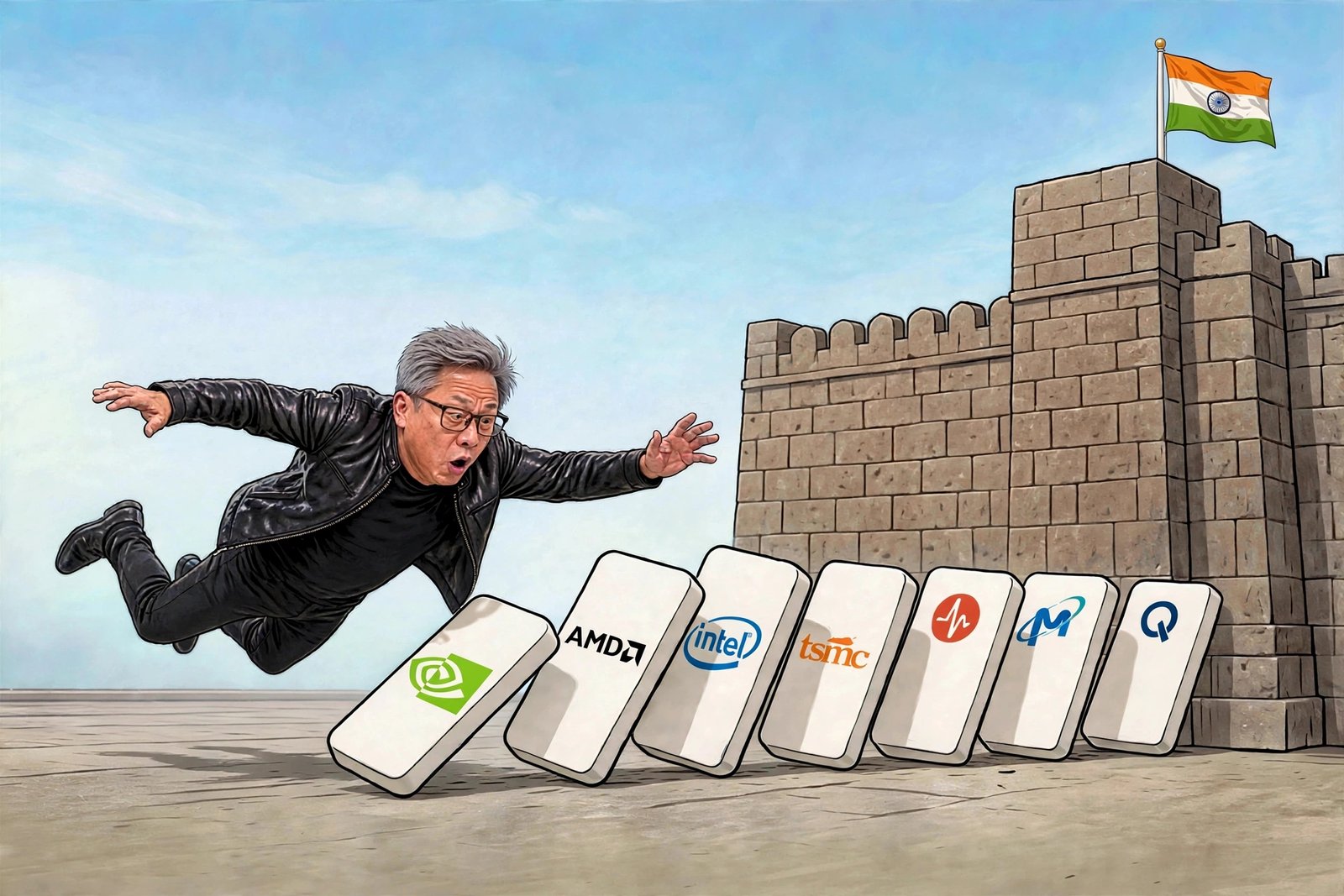
On Sunday 8 November 2026, Nvidia's board of directors announced an independent investigation, to be overseen by a committee of independent directors assisted by outside counsel, "in light of recent reporting that founder and CEO Jensen Huang has been the target of a foreign intelligence effort." The board stated in the same announcement that it "has no reason to believe that either national security or NVIDIA secrets were compromised," and that its inquiry would examine all available information. Nvidia published the statement on its own newsroom the same day, alongside a message from Huang to employees in which he wrote that he had been unfaithful to his wife, apologised to his family and colleagues, and said he supports the investigation and will cooperate fully.
The reporting behind the board's announcement is not Nvidia's record and is not established fact. The New York Times reported in late October and again in November that US intelligence officials suspect a businesswoman associated with Megaspeed, a Singapore-based Nvidia customer, of gathering information for China, and that Huang had a personal relationship with her. On 11 November the Times reported a second relationship, with an Nvidia executive. China has rejected the espionage allegations. Nvidia has not confirmed the reported details, and no investigation finding has been published.
What followed is on the record. On 11 November 2026, Nvidia's board accepted Huang's resignation as president, chief executive officer and board member, effective immediately. The company's Form 8-K, filed with the US Securities and Exchange Commission on 12 November, records that chief financial officer Colette M. Kress was appointed interim chief executive while the board searches for a permanent successor, and that Harvey C. Jones was appointed chair of the board. The filing gives no reason for the resignation. Separately, three US House committee chairmen, in a letter dated 4 November published by the House Foreign Affairs Committee, have asked Huang to attend a joint closed-door briefing on 18 November about his interactions with the Megaspeed executive and Nvidia's security protocols. A proposed shareholder class action was also filed in federal court in California on 9 November; its allegations are unproven.
The share price record, from Nasdaq market data, is as follows. Nvidia closed at $186.64 on Friday 6 November, the last session before the board's announcement. It closed at $178.67 on Monday 9 November, down 4.3 percent, and at $168.89 on Tuesday 10 November, down a further 5.5 percent. It recovered 2.9 percent on Wednesday 11 November to $173.73. On Thursday 12 November, the session in which the resignation was announced, it traded as low as $148.80 during the day before closing at $166.19, down 4.3 percent. On Friday 13 November it closed at $162.85, down 2.0 percent. Across the week the shares fell 12.7 percent, and they stand about 32 percent below their closing level of $239.24 on 6 October. Nvidia's third-quarter fiscal 2027 results remain scheduled for Tuesday 17 November, as the company announced on 28 October.
Past performance may or may not be sustained in future.
In India, the week's closing record from the National Stock Exchange is narrower than the headlines suggest. The Nifty 50 closed on Friday 13 November at 25,144.30, down 0.61 percent on the day and up 0.46 percent across the week. The BSE Sensex closed at 81,592.45, down 0.39 percent on the day. The Nifty IT index, the segment with the closest business links to the global technology cycle, closed Friday at 31,931.15, down 0.72 percent on the day and down 3.17 percent across the week, its weakest weekly performance after a six-week rising run. Foreign portfolio investors were net buyers of Indian equities through the week: the NSDL FPI monitor records net equity investment of Rs 84,291 crore for November through 13 November, and the exchanges' provisional figures for Friday show foreign investors net buying Rs 5,737 crore in the cash market while domestic institutions net sold Rs 2,254 crore.
Why it matters
A governance crisis at the world's most valuable chipmaker matters to an Indian investor only through the routes by which it can reach Indian holdings. Those routes are specific, and they are not the same for every holding. The honest map, holding by holding, is the substance of this brief.
Domestic equities. The channel is sentiment and flows, with a narrower read-across into the information technology segment. Indian IT services companies earn a large share of revenue from North American clients whose technology budgets are tied to the same AI investment cycle that Nvidia's results describe, so a shock to confidence in that cycle tends to appear first in the IT segment's prices. That is what the week showed: the broad index finished the week higher, while the IT segment fell 3.17 percent. What to look at: the NSDL daily FPI investment trends and the exchanges' provisional foreign and domestic institutional figures, which show whether global investors are treating India as part of the problem or as a destination away from it; and the Nifty IT index against the Nifty 50 at each close, which shows whether the read-across is widening or fading. What would have to change for this episode to matter materially to domestic equities as a whole: the investigation or the congressional process would need to produce measures that restrict the AI hardware trade itself, or Nvidia's 17 November results would need to show the episode reaching orders and demand, or foreign buying of Indian equities would need to reverse into sustained selling. What has not changed: the Nifty 50 ended the week above where it began it, foreign investors bought on every session of the week covered by the NSDL record, and nothing in Nvidia's filings alters any Indian company's reported earnings.
International equity exposure. This is the one holding the episode reaches directly. An Indian investor holding international equity exposure in general terms holds, among other things, exposure to large US technology companies whose prices set the tone for global equity portfolios, and a single company at the centre of the AI trade has fallen 12.7 percent in a week on a governance event. The channel needs no intermediary: it is the price itself, translated into rupees at the Reserve Bank of India's reference rate, which can cushion or amplify the dollar move in either direction. What to look at: Nvidia's results on 17 November and any statement in them about demand, orders and the leadership transition; the company's further SEC filings, which are where a permanent chief executive appointment or any investigation outcome will appear first; and the RBI reference rate on the days those results land. What would have to change for the episode to matter beyond price volatility: evidence in the results or filings that the episode has reached the business, in orders, guidance or export permissions, rather than the boardroom alone. What has not changed: Nvidia has filed nothing that revises its business outlook, its results date stands as announced on 28 October, and the investigation remains, on the board's own statement, an inquiry with no finding.
Gold. The honest answer is that there is no material channel from this episode to gold, and the week's gold prices moved for other, documented reasons. Gold is priced globally in dollars and responds mainly to US inflation data, the dollar and expectations for the Federal Reserve's December meeting. Spot gold closed the week lower, with market data showing a fall of about 4.5 percent across five sessions, and MCX gold futures fell sharply on Thursday 12 November alongside the same US inflation and dollar drivers that the market record attributes the move to. A scandal at one US company, however large, does not change any of gold's drivers unless it grows into a general confrontation between the US and China over technology, and even then the channel would be the generic one that reaches every asset in a risk shock, not a gold-specific one. What to look at, for gold itself: the Federal Reserve's December decision path and the dollar, which are the forces that actually moved the metal this week. What has not changed: everything that determines the gold price this month is a macroeconomic variable, none of which this episode touches.
Debt, meaning bond exposure held through debt funds and government securities. There is no material channel from this episode either, and the proof is that Indian bond yields moved this week for reasons that are fully accounted for at home. The benchmark 10-year government security yield closed on Friday 13 November at 7.31 percent, up from 7.25 percent the previous day. The market record attributes that move to domestic data: the Ministry of Statistics and Programme Implementation reported on 12 November that consumer price inflation for October 2026 was 6.09 percent, provisional, above the upper bound of the Reserve Bank's tolerance band, with food inflation at 8.94 percent, and to rising US Treasury yields. What to look at: the Reserve Bank's monetary policy decision on 2 to 4 December, the November inflation print due on 14 December, and government security auction results published by the Reserve Bank, which together set the path for the yields that debt holdings are priced from. What would have to change: the episode would have to move US Treasury yields or global oil prices materially and persistently, neither of which it has done; this week's crude oil strength is attributed in the market record to Middle East developments, a separate story. What has not changed: the repo rate stands at 5.50 percent, set by the Reserve Bank on 7 October, and the questions facing Indian debt are Indian questions about inflation.
Cash and liquid holdings. There is no channel at all. Cash and liquid holdings are priced off domestic money market rates anchored to the repo rate, and nothing in an American boardroom investigation reaches them. They are in this map because a complete map says so plainly rather than leaving the reader to wonder. What has not changed: everything.
The desk's reading, at asset-class level, is this. On the primary evidence available today, the Jensen Huang episode is a single-company governance event whose transmission to Indian investors is narrow and identifiable: direct price exposure for international equity holdings, a sentiment and segment channel for domestic equities that the week's flow data so far contradicts more than confirms, and no material channel to gold, debt or cash. The counter-case deserves equal weight. Governance events at systemically important companies can widen: the congressional briefing requested for 18 November could give the episode a policy dimension, the investigation has published no findings, and Nvidia's results on 17 November are the first hard test of whether the business itself is untouched. If any of those change the facts, the map above changes with them, and this desk will redraw it in the open.
What changed
Four things genuinely changed this week. First, Nvidia has a new chief executive on an interim basis and, for the first time, a chair of the board, and a founder who defined the company for three decades has left it; that is a permanent governance fact regardless of what the investigation finds. Second, the episode acquired institutional dimensions beyond the company: a congressional briefing request with a date attached, and a shareholder lawsuit on file. Third, the price of the central stock in the global AI trade fell 12.7 percent in a week, which reprices every portfolio and index that carries it, including international equity holdings in India. Fourth, within Indian equities, the information technology segment's six-week rising run ended with a 3.17 percent weekly fall, the clearest domestic fingerprint of the episode. What also changed, and should not be buried, is India's own data: October inflation at 6.09 percent crossed the Reserve Bank's tolerance ceiling during the same week, and that, not Nvidia, is the development with the most direct consequences for Indian debt and for the December policy meeting.
What has not changed
Nvidia's products, customers and order book appear in no filing this week as changed; the company's results are still due on the date announced in October, and its board's last word on the security question remains that it has no reason to believe national security or company secrets were compromised. India's domestic investment engine has not changed: the Association of Mutual Funds in India reported on 11 November that systematic investment plan contributions in October were Rs 32,160 crore across roughly 10 crore contributing accounts, the third consecutive month above Rs 32,000 crore, and that equity schemes recorded their 68th consecutive month of positive net inflows at Rs 32,994 crore, with industry assets at Rs 83.39 lakh crore. Those October figures predate this episode, and their value here is as a baseline: the November figures, published in December, will show whether Indian households changed their behaviour during a noisy global month, and until then any claim that they have is speculation. Foreign investors, for their part, spent the week buying Indian equities, not leaving them. And the Reserve Bank's stance, the inflation problem and the December meeting calendar are exactly where they were before anyone in Santa Clara resigned.
What we are watching
Each item below is frozen as a pre-registered expectation in the desk's record, in the format the operating plan sets.
Watch item 1: Nvidia's third-quarter fiscal 2027 results. Event and date: Results announcement and earnings call, Tuesday 17 November 2026, after the US market close, as announced by Nvidia on 28 October 2026. Prior reading: Nvidia shares closed at $162.85 on Friday 13 November 2026 (Nasdaq market data); the company's last SEC filing is the Form 8-K of 12 November recording the leadership transition. Published consensus: None found in the primary sources the desk uses. The record states this rather than substituting an estimate. The desk's reading: The results and the accompanying statements will show whether the episode is confined to governance. Demand, order and guidance language unchanged from the company's prior communications would support that reading; any linkage of business measures to the episode would not. Confirm: Results are reported with no revision attributed to the episode, and the interim leadership addresses the transition directly. Refute: Guidance is withdrawn or revised with reference to the investigation, the leadership change or export permissions.
Watch item 2: The requested congressional closed-door briefing. Event and date: Joint closed-door briefing requested for Wednesday 18 November 2026, per the House Foreign Affairs Committee's publication of the chairmen's letter dated 4 November 2026; the letter asked for acceptance or an alternative date by 11 November. Prior reading: No public confirmation of the briefing's occurrence or content exists at the source cut-off; reporting indicates committee staff have been in contact with the company. Published consensus: None found; not applicable to an event of this kind. The desk's reading: Whether the briefing happens, and whether anything public follows it, determines whether the episode stays a governance matter or acquires an export-control and security policy dimension, which is the route by which it could widen to Indian equities beyond the IT segment. Confirm: The briefing takes place or is rescheduled with no announced policy measures following it. Refute: Committees announce measures on chip exports or security conditions tied to Nvidia following the briefing.
Watch item 3: Foreign portfolio flows into Indian equities, week of 16 to 20 November. Event and date: Daily NSDL FPI investment trends and exchange provisional institutional figures across the week of Monday 16 to Friday 20 November 2026. Prior reading: NSDL records net FPI equity investment of Rs 84,291 crore for November through 13 November 2026; exchange provisional figures for 13 November show net foreign buying of Rs 5,737 crore in the cash market. Published consensus: None found; flows are recorded data, not surveyed expectations. The desk's reading: Continued net buying through a week containing Nvidia's results would confirm that global investors are, so far, separating the episode from their India allocation. Sustained net selling coinciding with US technology weakness would be the first flow evidence against that reading. Confirm: NSDL daily trends show net buying on balance across the week. Refute: Three or more sessions of net selling in the NSDL record during the week.
Watch item 4: The information technology segment against the broad market. Event and date: NSE closing data across the week of 16 to 20 November 2026. Prior reading: For the week to 13 November 2026, the Nifty IT index fell 3.17 percent while the Nifty 50 rose 0.46 percent (NSE closing data). Segment moves can be sharp in both directions, and a single week of underperformance in a segment is a normal market event as often as it is a signal; that risk framing applies to every reading of this item. Published consensus: None found. The desk's reading: If the segment's underperformance was a sentiment read-across from the US technology shock, it should stop widening once the 17 November results are known, one way or the other. Continued sharp underperformance after the results would suggest the market is pricing something more durable about the AI investment cycle that Indian IT revenues depend on. Confirm: The weekly gap between the Nifty IT index and the Nifty 50 narrows relative to the week to 13 November. Refute: The Nifty IT index underperforms the Nifty 50 by a wider margin than the week to 13 November, after the results are public.
Sources: US Securities and Exchange Commission, NVIDIA Form 8-K, filed 12 November 2026; NVIDIA newsroom, board statement and message to employees, 8 November 2026; US House Foreign Affairs Committee, press release, 5 November 2026; National Stock Exchange of India, closing data, week to 13 November 2026; Bombay Stock Exchange, closing data, 13 November 2026; National Securities Depository Limited, FPI monitor, November 2026 to 13 November 2026; Ministry of Statistics and Programme Implementation, Consumer Price Index for October 2026, released 12 November 2026; Association of Mutual Funds in India, monthly industry data for October 2026, released 11 November 2026; Reserve Bank of India, monetary policy decision, 7 October 2026.